
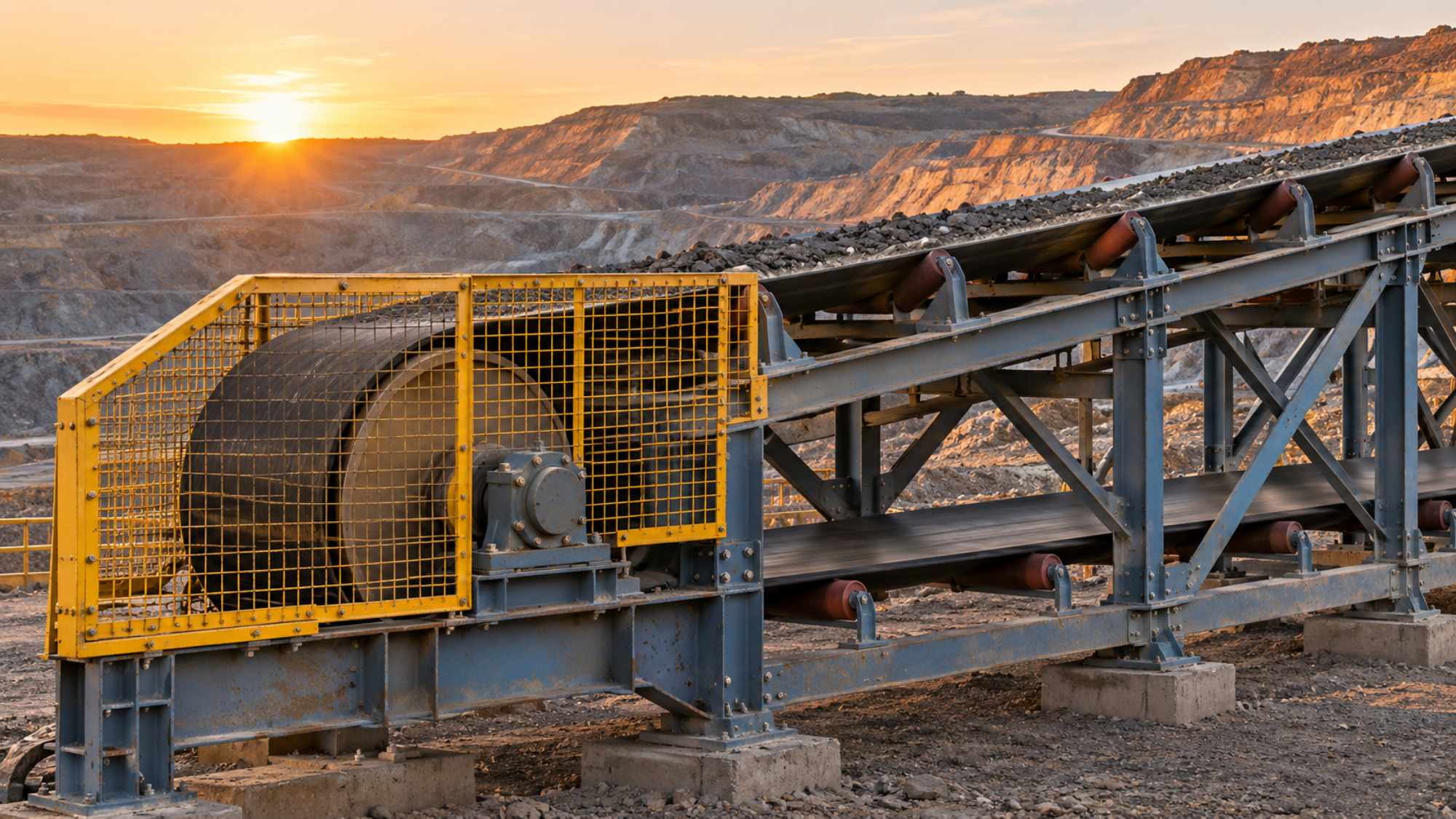
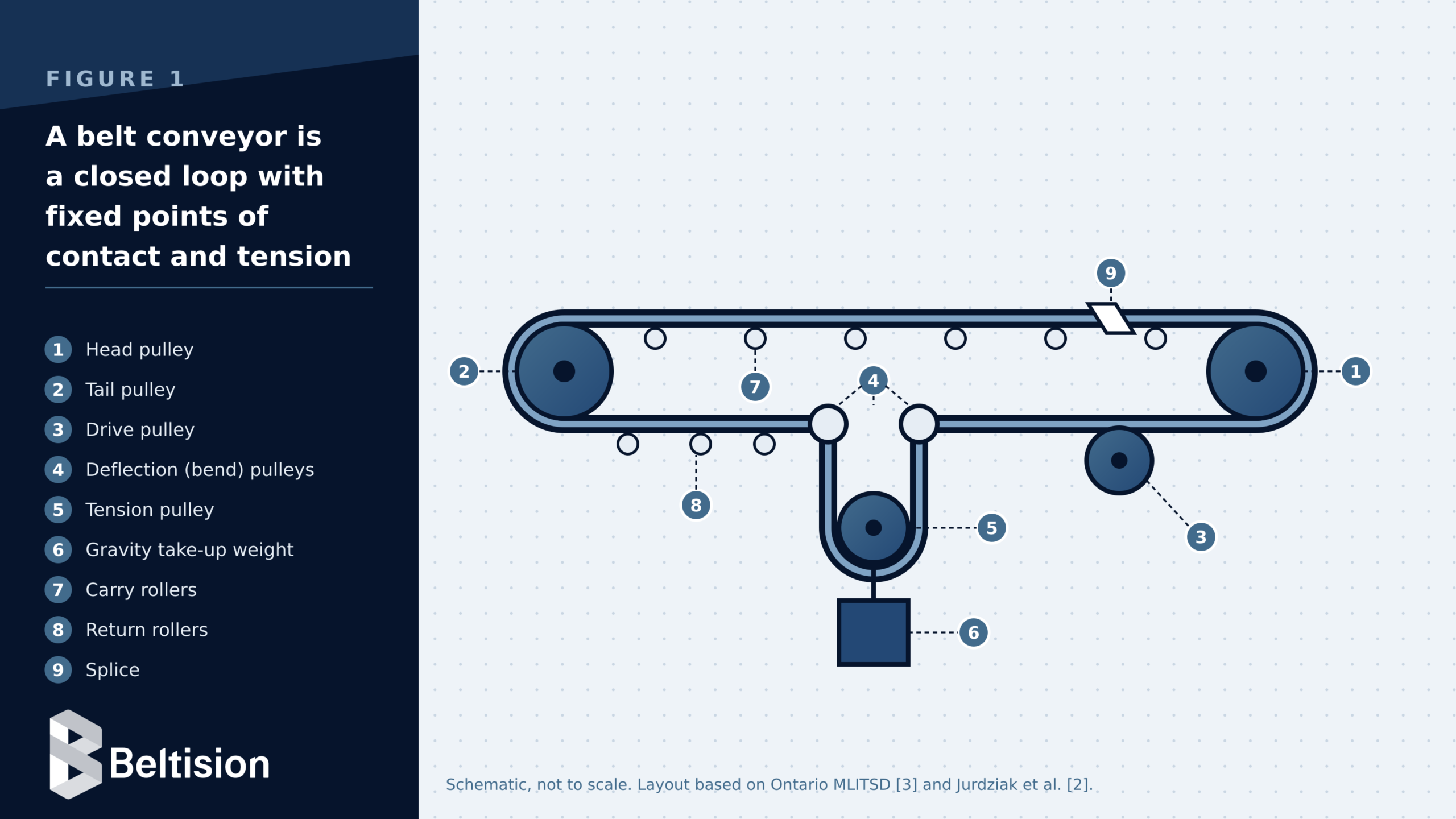
The US Mine Safety and Health Administration (MSHA) describes conveyor systems as an important way to move material at surface and underground mines, from a single belt to a series of belts spanning miles [1]. It also states that all conveyor systems have inherent dangers while in motion [1]. Most discussion of belt condition starts at the belt itself, but a conveyor is a set of parts that load one another, and both damage and injury cluster at particular points. This article walks through those parts, what sets the forces in the belt, and where problems concentrate. Figure 1 shows the layout used throughout.
A belt conveyor carries material on a belt that runs in a closed loop. Jurdziak and colleagues note that belts are assembled into a closed loop from several sections, which arrive at the installation site on reels [2]. The loop turns around pulleys. Guidance from the Ontario Ministry of Labour, Immigration, Training and Skills Development names the head, tail, drive, deflection and tension pulleys, and the carry and return rollers [3]. In a gravity take-up, which provides tension for the belt, a free weight hangs on a tension pulley from deflection (bend) pulleys on the return side of the belt [3].
The belt itself has a layered structure. A review of non-destructive testing for conveyor belts describes rubber cover layers and load-bearing elements, which are fabric plies or steel cord reinforcement [4]. Jurdziak and colleagues classify belts as textile-reinforced or steel cord-reinforced according to the core material, and describe the core as the layer that transmits the longitudinal forces needed to move large masses of material [2]. Textile-reinforced belts may be joined by hot vulcanization, cold bonding or welding, or mechanical fasteners; steel cord belts are joined only by hot vulcanized splices [2].
A splice is the joint that closes the loop, and the belt core loses its continuity over a short region there [2]. For that reason Jurdziak and colleagues describe the splice as the weakest link in the loop [2]. They report that splices are susceptible to damage and irregularities arising from assembly errors, improper vulcanization parameters or unfavourable operating conditions [2].
International standard ISO 5048 covers the forces that load this loop. According to its published scope, it specifies methods for calculating the operating power needed at the driving pulley and the tensile forces in the belt of conveyors with carrying idlers. It also defines terms, symbols and units, the resistances to motion, the driving force and power requirements, and the capacity and cross-section of a conveyor with a smooth patternless belt [5]. The 1989 edition was last reviewed and confirmed in 2026, and ISO lists it as current [5]. This article uses only the scope text, which is public; the formulas and values are in the full standard and are not reproduced here.
The same review lists the common failures: surface wear, cuts, longitudinal tears, delamination of cover layers, damage to the steel cord core and local overheating caused by friction [4]. Surface wear is the most common type of damage and results from contact between the belt and the conveyed material [4]. Cuts and tears are typically sudden and severe, and often mean replacing a whole section of belt [4]. Fracture or corrosion of steel cords reduces tensile strength [4]. The authors name sharp foreign objects, structural misalignment, local overstressing and splice defects as root causes of sudden failures [4]. A separate article in this series covers the damage types and their causes in detail.
The parts that load the belt are also the places where people get caught. Ontario guidance says accessible pinch points must be guarded at the head, tail, drive, deflection and tension pulleys, and at the return and carry rollers where the lift of the belt is restricted; guards generally extend at least 0.9 metres from the pinch point unless they make it inaccessible [3]. MSHA reports that fatal accidents related to working near, inspecting, adjusting or maintaining conveyor belts occur each year at underground and surface mines [1]. Its key practices include locking out and tagging out energy at the source during maintenance, guarding moving parts including rollers and the head and tail areas, and installing pull cords for emergency stops [1]. The Ontario guidance states that it does not replace the Occupational Health and Safety Act or its regulations and is not legal advice [3]. Two companion articles in this series cover safety practice and Ontario’s mining regulation.
Any conveyor can be read with a few plain questions. Where are the splices, and how were they made and inspected? Which pinch points can be reached, and are the guards in place at the distances the rules ask for? What do the maintenance records say about wear, cuts and overheating, and where on the loop were they found? Which calculation sets the drive power and belt tension, and where is it documented?
References
- Mine Safety and Health Administration. Safety topic: conveyor systems [Internet]. Arlington (VA): U.S. Department of Labor; [cited 2026 Nov 10]. Available from: https://www.msha.gov/node/232931
- Jurdziak L, Błażej R, Rzeszowska A. Non-destructive diagnostics in the assessment of splice geometry in steel cord conveyor belts. Appl Sci. 2025;15(9):5034. doi:10.3390/app15095034. Available from: https://doi.org/10.3390/app15095034
- Ontario Ministry of Labour, Immigration, Training and Skills Development. Conveyor guarding in mines [Internet]. Toronto: Government of Ontario; updated 2024 Nov 7 [cited 2026 Nov 10]. Available from: https://www.ontario.ca/page/conveyor-guarding-mines
- Rzeszowska A, Błażej R, Jurdziak L. Non-destructive testing for conveyor belt monitoring and diagnostics: a review. Appl Sci. 2025;15(24):13272. doi:10.3390/app152413272. Available from: https://doi.org/10.3390/app152413272
- International Organization for Standardization. ISO 5048:1989 Continuous mechanical handling equipment. Belt conveyors with carrying idlers. Calculation of operating power and tensile forces [Internet]. Geneva: ISO; 1989 [reviewed and confirmed 2026; cited 2026 Nov 10]. Available from: https://www.iso.org/standard/11069.html